What if I don't love my baby? Fear of not loving one's baby.
- Alexis Robic
- Feb 26
- 4 min read

An inner, taboo fear, but profoundly human.
A question that's not asked aloud . What if I don't love my baby? The fear of not loving one's baby.
"I'm afraid I won't love him/her. Afraid I won't feel that connection. Afraid I won't be able to love properly."
At Inné, we also support those silences. Those fleeting, then obsessive thoughts. Those doubts buried beneath the social “everything is fine”.
Because the fear of not loving one's baby is not an aberration. It is often a deep signal , a memory , a tension between history and the present .
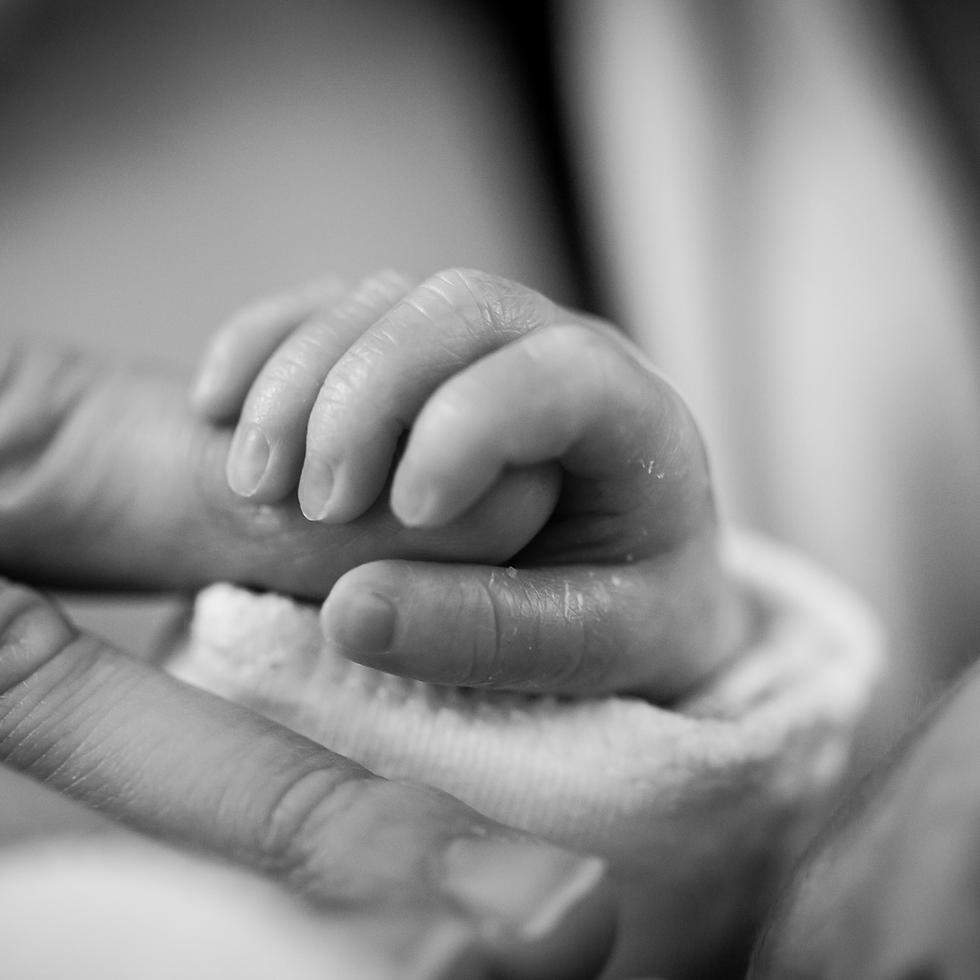
What this fear of not loving your baby might be hiding
This fear can have many faces:
• The fear of a visceral rejection,
• The anxiety of not being a “good mother”,
• The feeling of being emotionally “cold” or inadequate,
• Projecting a childhood wound: “What if I repeat what I received?”
This fear doesn't mean you're incapable of loving. It might mean your body or your heart hasn't yet been allowed to love freely.
What science and psychology confirm
1. The attachment bond can be delayed — and that's normal
“Postpartum Bonding Questionnaire (PBQ): a screening tool for early disorders of the mother–infant relationship” Brockington et al., Archives of Women's Mental Health, 2006
One in five mothers may experience a lack of immediate emotional connection with their baby in the first few weeks, without this affecting long-term attachment, if this experience is acknowledged and supported.
2. Attachment traumas influence the mother-child bond
“The Impact of Unresolved Attachment Trauma on Maternal Behavior” Lyons-Ruth et al., Development and Psychopathology, 2006
A mother who was unable to receive a secure attachment in her own childhood may experience a fear of repeating the pattern, or conversely, a blockage in accessing love.
3. Perinatal stress affects the emotional bond
“Effects of prenatal maternal stress on child outcomes” Van den Bergh et al., Neuroscience & Biobehavioral Reviews, 2005
High levels of stress before or after childbirth alter the production of oxytocin , the central hormone of attachment and tenderness.

What if it wasn't a fear... but a memory?
"Why am I afraid I won't love my child?"
"Will I be a good mother if I don't have that epiphany right away?"
"What if I'm not capable of loving properly?"
We often hear these questions phrased... in half-spoken words. But they express something sacred: The need to love deeply, in a different way.
This that we observe in Innate
Among women who express this fear, we often find:
Plan | Observed elements |
Emotional | Attachment wounds, feelings of inadequacy, latent guilt |
Transgenerational | Stories of women who passed on their heritage “without connection,” family silence, unresolved grief. |
Neurological | Nervous system stuck in vigilance mode, preventing access to the gentle bond |
Fascial | Tensions in the diaphragm, heart, or pelvis (area of attachment and reception) |
Hormonal | Postpartum cortisol or oxytocin imbalance, chronic fatigue |
What we need to dare to hear
• No, the link is not always immediate.
• No, you are not “cold”.
• No, it's not a maternal failure.
• Yes, you have the right to feel like a stranger to your baby in the first few days.
The bond is forged, it cannot be decreed. It is not measured by "love at first sight". It needs time , physical presence , and inner security .
What we do at Inné
We support the woman before the mother. Because it is she, in her integrity, who weaves love, not an “automatic” instinct.
Our treatments combine:
Body
• Gentle stimulation of the natural production of oxytocin
• Rebalancing of the nervous system (shift from protection mode to connection mode)
Emotion & History
• Acknowledging and verbalizing fear, without judgment
• Transgenerational work on the maternal lineage
• Couples sessions so that the partner supports the bond, not just the effort
Integration
• Sensory reconnection with the baby (even remotely or in utero)
• Gentle centering practices (visualizations, breathing, touch, singing)
• Postpartum support focusing on bonding, fatigue, and body memory
What we believe
You're not supposed to be perfect.
You are supposed to be here, present, in truth.
And that's where love is born.
Not in immediate ecstasy, but in coherence , tenderness , and sometimes… in repair .
Make an appointment
We offer:
• Preconception and pregnancy sessions to soothe maternal memories
• Postpartum support for the mother-baby bond
• Treatments to open up the space of the heart and pelvis
• Couple counseling to support the acceptance of the bond
• Remote or in-person care , depending on where you live
Contact us
WhatsApp: 06 99 20 06 70
You don't have to force love.
You have to allow yourself to welcome it , as it comes.
At your own pace. With your story. With your scars.
And that's what we're here for.
Not to trigger anything.
But to reweave what is already within you , and which has been waiting, perhaps for generations, to be passed on in a different way.

Comments